Ready, set, trek! Some members of our adventure team picked us up at Albergue Churup at the bright and early hour of 6:15. Inga and I had packed everything the night before and had a shower (the last one for 10 days) so we were all set to go in the morning.
The van was filled with everything the six of us would need for the next 10 days. Our packs, not having been this light for quite some time, were added to the food, the "bathroom" tent; the cooking tent; the eating tent; our guide Eli's tent, and the combination tent for Humberto, the cook, two arrieros and supplies. After the paperwork was complete, we dropped off Ted, the Skyline rep, and headed to the mountains.
Our adventure team of Eli, our kind and very knowledgeable guide and leader; Humberto, cook extraordinaire (vegetarian cooking was not a challenge for him); the super sweet arrieros and a full complement of four legged friends: five mules, three donkeys and two horses.
The three-hour van ride to the trailhead was an adventure in itself. Vehicles casually drift from right to left and left to right to avoid the many potholes. We stopped along the way to have breakfast on the side of the road, and what a satisfying breakfast it was! A flacky pastry filled with apple and cinamon (and not too sweet at all), a lactose-free yogurt drink and a banana grown right here in Peru. A very fine start to Humberto's delights.
And then there was the drive up the mountain; the dirt road was very (very) narrow and had rocks and bumps to add to the thrill. Up and up we went past fertile fields of corn, potatoes, alfalfa (the food of choice for guinea pigs) and other vegetables that I did not recognize. What hard working people they are. Fields are tilled by bulls and harvest is done by hand.
We started the hike while the arrieros, with some help from Huberto, packed up the gear and the donkeys and one of the horses. We walked slowly in the splendid sunshine and my mind was blown. I can't believe where I am and all of the splendour I have seen. And this is only the beginning of the trek!
I am enveloped by the mountains.
Saturday, November 19, 2011


A year ago today ...
We reached the summit of 6,088 m (19,975 feet) high Huayna Potosi in the Cordillera Real in Bolivia. Re-reading our post from that awesome adventure today.
Thursday, November 17, 2011
Red Book Entry: October 18 (again)
Laguna Churup. What can I say to truly reflect its magnificence? Cecilia gave us some beta on how to get to the trailhead so off we went going "... straight down the road. Just before it starts to curve left, turn right unto a herd path. You will see a partially built building. Turn just past the trees."
We were met at the trailhead by two park officials. Once our park passes were verified (we had purchased them at the trailhead to Laguna Llaca) and the requisite paperwork filled out (I wonder what they do with the profession information?), we started our hike up to 4,400m in full sunshine.
On the trailhead we met ... no one. So we found ourselves perfectly on our own in this expansive landscape. We walked at a pace that allowed us to be steady and have a certain rhythm. We had frequent stops to catch our breath and get oxygen back into our legs.
After a scramble up a rockface that had been equiped with cables, we headed up a waterfall which, we would soon find out, was not the way to go; it was much easier to stay right and hike up the slabs. Great fun, though.
I would have hiked more than twice the distance to set my eyes on the patterns of colours of the laguna. Cerro Churup with its glaciers (although you can tell that they are not as big as they once were) was poised as a stunning backdrop.
Wednesday, November 16, 2011
Red Book Entry: October 18, 2010
Today marks the end of our first week in S.A. And, as is the case when I travel, time expands. I can't quite wrap my mind around all of the experiences I have had.
I am cozy in the tent with Inga, all my posessions (although I did leave a few items in Huaraz) and a warm bottle of mate de coca at the bottom of my sleeping bag (a trick I learned from Poppy, our guide on Aconcagua in 2007). Tonight is the third night camping at the Way Inn, a perfect lodge roughly a three-hour walk from Huaraz. We took a taxi to get here but plan on walking back to town with Cecilia, an interesting woman who works at the lodge occasionally.
Part of the reason why we came here was to acclimatize and to camp in Peru for the first time. As well, there is some excellent hiking here. Yesterday we simply went for a three-hour walk along the aquaduct and spent the whole time uttering superlative after superlative.We had the company of the three dog pals who live at the inn. They made the walk all the more enjoyable.
There is a reason we did not go for a big hike; I apparently picked-up a gastro problem along the way. I had major belly aches for three days and diarrhea a plenty. The day we arrived at the inn I did nothing but sleep (and go to the bathroom, of course). As it turned out, that was a fine thing to do because we had a major thunderstorm without any lightning. Weather in the mountains is changeable, to say the least.
Tuesday, November 15, 2011
Red Book Entry: October 14, 2010
We took a cab from Albergue Churup to El Pinar to start our first hike. El Pinar is a new "modern" gated community that was constructed about seven years ago to house the people who work for one of the mines.
The trek led us through the countryside and pueblitos. What a different world from the one I inhabit. Families own small parcels of land on which they grow food for their own consumption. We met traditionally dressed women herding their sheep or cows or oxen or pigs down the road, coming from or going to the fields to graze. Their houses, mostly made of adobe, are simple and many of them are painted with polical campaign messages (they apparently get paid to have these messages on their houses).
In the fields, or on a small patch of land in front of or beside the houses, animals are tethered rather than fenced in. The chickens run free (what we call "free range" chickens and pay more for) and dogs are everywhere.
After three hours of walking uphill, we reached Wilkawain, an archeological site. There were two buildings, one a three-story house that we were able to enter. The stone building is still standing solidly, quite a testament to the building science of the people.
While I was taking in the view and wrapping my mind around just where I was, a young man came over to say hello. (I am so glad that I know enough Spanish to have a conversation with Peruvians.) We spoke easily and freely and were soon joined by Inga. We continued to connect for a good 30-45 minutes before we carried on with our visit.
To get back to Huaraz, we took a collectivo, a van of sorts that picks people up who flag it along the way. Inga and I ended up sitting in the front seat which, as it turns out, were the best seats in the house. More and more people pilled into the van for the roughest (and quite exciting!) ride I have had. All this fun for 2 soles.
Monday, November 14, 2011
Red Book Entry: October 13, 2010
I still can't believe that I am in Peru, being in another time and space and living very differently from my regular world.
Breakfast at Albergue Churup [in Huaraz] is totally amazing, from the clean and bright room, to the 180 degree view of the mountains, to the lovely people, to an amazing fruit salad. Pineapple is in abundance and tastier than any pineapple I have ever had. The albergue is busy but not full; just enough people to add to the positive vibe. This breakfast room can be used until 23h, making it a perfect spot to read and write and contemplate being.
I had a wonderful nap this afternoon (I am sleeping and sleeping and sleeping) after exploring Huaraz. Dogs are a plenty; street vendors sell food from their carts and women move effortlessly despite carrying a child, or wood, or long grasses (not sure what they use them for) [found out later that the grasses are alfalfa that they feed their guinea pigs that they raise as food] They use colourful pieces of cloth drapped over their shoulders and carried on their backs as snugglies for their infants and carry whatever needs to be carried. One thing that fulfills various needs.
I have not noticed many flowers growing in front of houses. What I have seen, however, makes up for the volume -- beautiful white calla lilies grow in abundance. They are not indigenous to Canada and are quite expensive to buy so it's delightful to see so many, including a huge bouquet in the sitting area just outside our room. Splendid.
Sunday, November 13, 2011
Cena a la chilena :)


First Walleye Ceviche. The marinade was made with lime, red wine vinegar, cilantro, onions, red peppers, hot chili peppers, sea salt.
The vegetarian version used the identical marinade on fresh morzarella. (The fish after nearly an hour of "cooking" was perfect. The cheese, well, it works if you are vegetarian.)
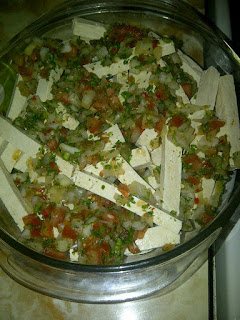
The main course was this awesome Pebre and Tofu dish with stuffed bell peppers served on hydroponic boston lettuce. Simmered for about 30 minutes and served with Pebre (cold).
The wine selection included whites from New Zealand (Oyster and Monkey Bay) and this really lovely, smooth Apothic Red from California that Sylvie brought.
Lemon meringue pie - by our pal Jan - topped it all off just so.
Saturday, November 12, 2011
Chilean dinner
Putting into practice once again what we learned with chef Gonzalo Lara at Cafe Vinilo in Valparaiso, Chile. They are on Facebook here.
We've prepared Ceviche a la Chilena (using Walleye and fresh Mozarella for the vegetarian version) for the starter. Then we made Pebre - an awesome, ubiquitous Chilean salsa - that we are using to marinate the main comprised of slow fried tofu strips and baked bell peppers stuffed with quinoa, mushroom and zucchini.
Desert will be arriving with one of our guest. Pictures will be posted once everything is plated :)
Friday, November 11, 2011
Patagonia Trip Planning

We've spent about 5 weeks in Patagonia so far: first time in 2007 when we went to the small town of El Bolson, Argentina after our trek to Basecamp at Aconcagua and then all of December 2010 as part of our 3 months Andean trip spanning Peru, Bolivia and Chile.
I am scheming already: can we live there - trekking and climbing mountains - for 3 months again? More boldly, how can travelling become what I do?
Meanwhile I am putting pre-requisites in place:
I'm continuing my Spanish studies begun in early 2010 at UNAM. And we are looking into training re: independent mountaineering skills. We also want to spend some time in the Adirondaks for winter ascents of some of the High Peaks. And we are checking into ski trips to the mountains of Colorado.
More than dreams.
Wednesday, November 9, 2011
180 South = Trip planning!
We just watched this awesome movie on DVD. There are a few stars in it but none greater than Patagonia itself. I love Patagonia.
I learned that there's a new park about to open to the public: Conservacion Patagonica. Who's behind this new park? A couple of Americans; one who once was a blacksmith, climber and surfer and started first Black Diamond and then, well, Patagonia, and the other the chap who started The North Face and later ESPRIT.
The footage in the movie is everything I have ever seen and loved about being in Patagonia. And, it conspires with some trip planning: we have begun to think about climbing Aconcagua and when you go that far south it's only natural to want to spend a little more time ... and it is an objective that will take some training to do well.
Meanwhile, check out this movie to see for yourself what it is all about.
Subscribe to:
Posts (Atom)